Welcome to ler’s documentation!

ler
ler (/ˈɛlɚ/): LVK (LIGO-Virgo-KAGRA collaboration) Event (compact-binary mergers) Rate calculator and simulator.
ler is a statistical based python package whose core function is to calculate detectable rates of gravitational waves events (both lensed and un-lensed events). Description available in the Summary section.
ler is closely integarted with a gravitational waves SNR calculator package gwsnr.
ler main developer: Hemanta Ph.ler developer and analyst: Anupreeta More, Harsh Narola, Ng Chung Yin (Leo), Justin Janquart, Chris Van Den Broeck, Otto Akseli Hannuksela, Neha Singh, David KeitelGlossary
- Gravitational waves
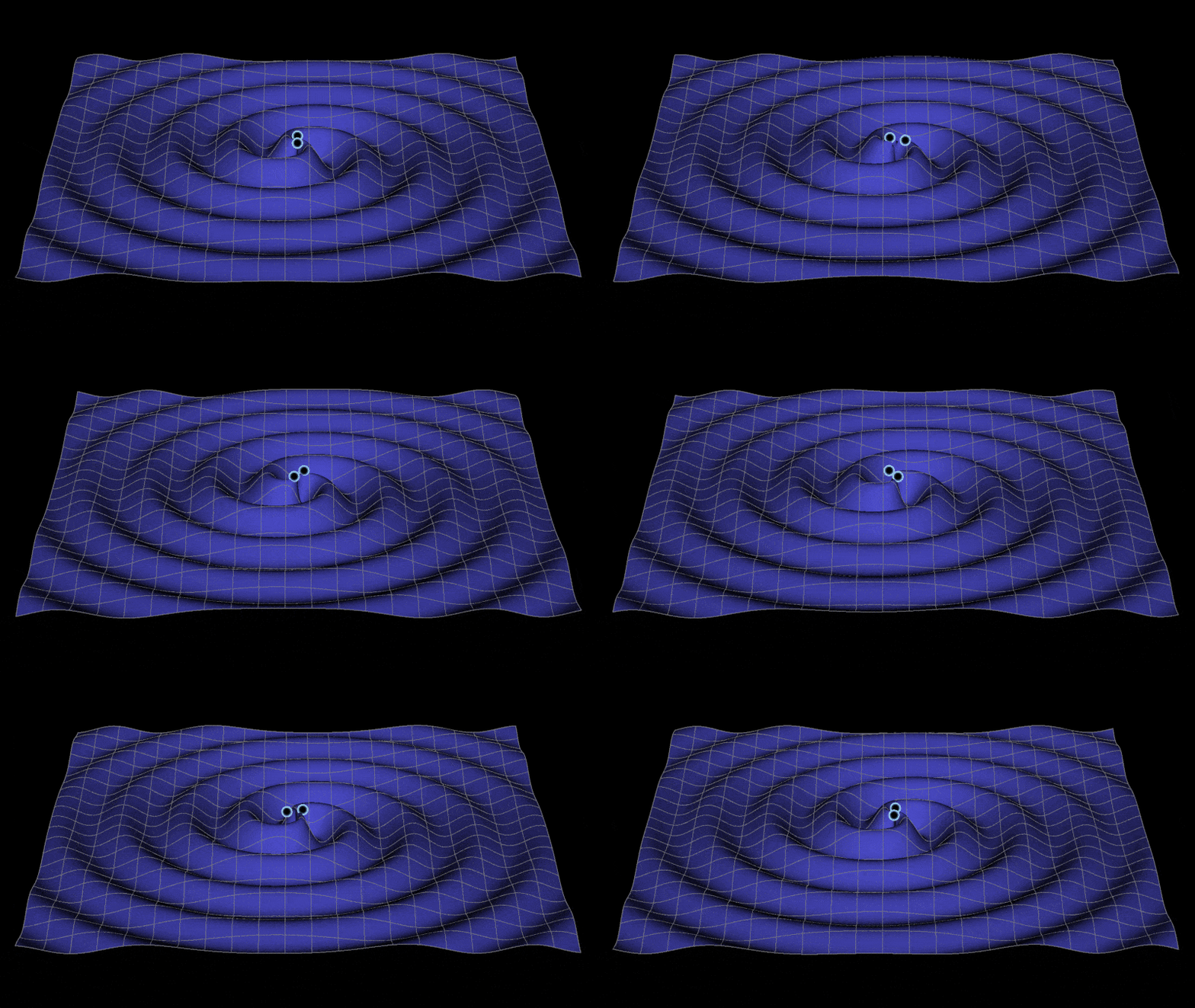
Animation showing the propagation of gravitational waves from inspiraling binary black holes. Source : Jeffrey Bryant, Wolfram|Alpha, LLC.
Ripples in the fabric of space-time caused by some of the most violent and energetic processes in the Universe, such as merger of compact binaries (e.g., black holes and neutron stars) and supernovae explosions. Albert Einstein predicted the existence of gravitational waves in 1916 in his general theory of relativity, but it took a century to detect them directly. The first detection was made in 2015 by the LIGO and Virgo collaborations, which won the 2017 Nobel Prize in Physics. Gravitational waves are invisible, yet incredibly fast; they travel at the speed of light, squeezing and stretching anything in their path.
- Lensing of gravitational waves
Interactive animation showing the lensing of gravitational waves by a massive object.
A process similar to the gravitational lensing of light, where gravitational waves emitted from distant astrophysical events are bent and splitted (strong-lensing case) into multiple images by the gravity of intervening massive objects, such as galaxy and galaxy cluster. This can magnify and change the arrival time of the gravitational waves.
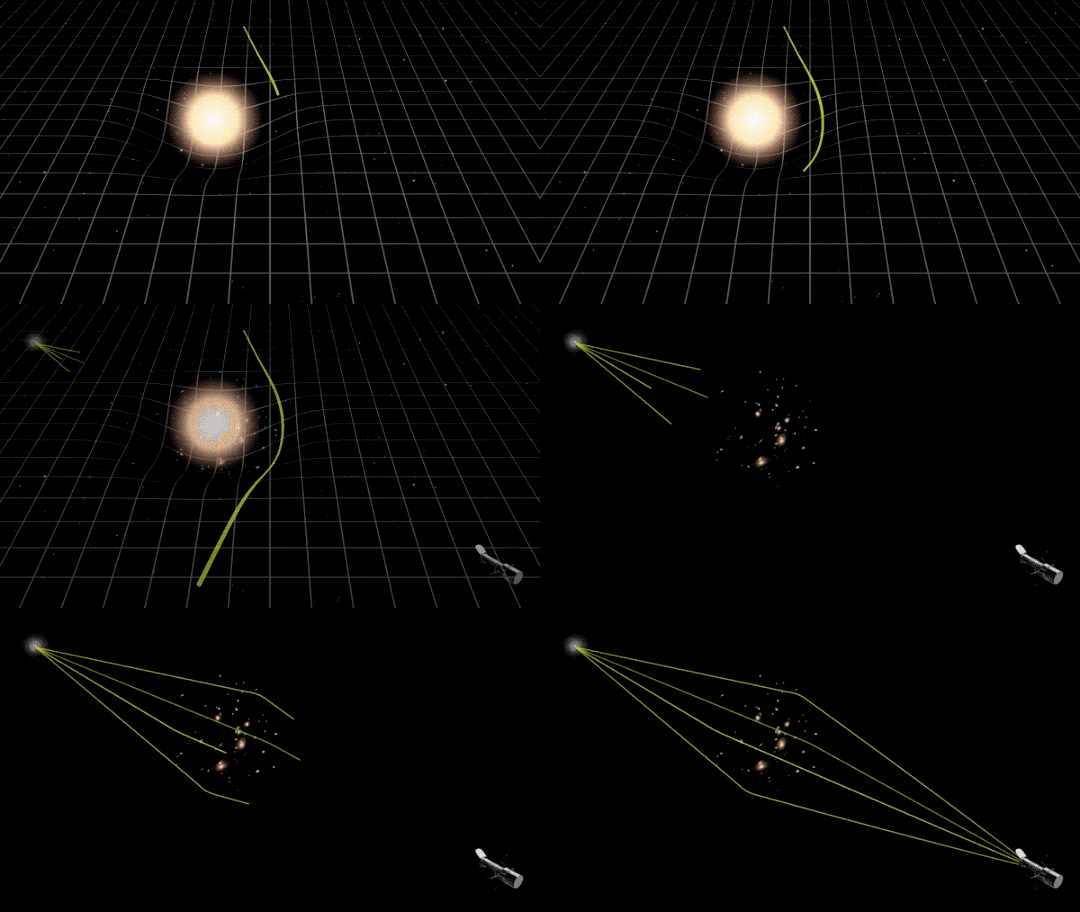
Animation showing the bending of light by a massive object. Source : NASA, ESA, and Goddard Space Flight Center/K. Jackson.
- Rate calculation and statistics
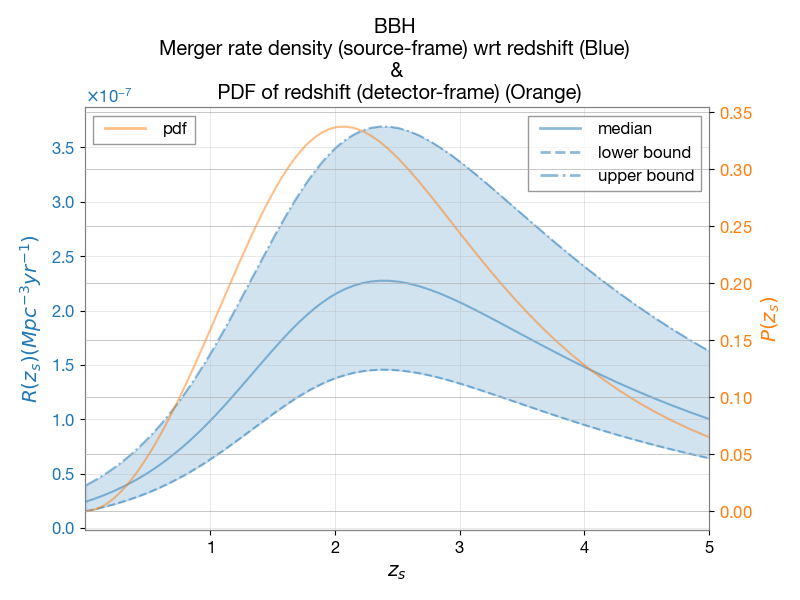
Figure showing the merger rate density of binary black hole (BBH) mergers as a function of redshift. Source : generated by the LeR package.
In the context of astrophysics and gravitational wave science, rate calculation involves predicting the frequency of events such as compact-binary mergers based on observed data and theoretical models. Statistical methods are used to analyze and interpret the data, estimate parameters, and test hypotheses.
Contents:
- Installation
- Summary
- Code overview
- Gravitational wave event rates
- Gravitational wave events sampling (Analytical formulation)
- Lensed event rates
- Annual Rate of Detectable Lensed Gravitational Wave Events
- SNR Operator for Lensed Gravitational Wave Events
- Redshift distribution of lensed GW compact binary coalescences (CBC)
- Sampling Lens Properties
- Sampling of Source Position
- Calculation of Images properties
- Statistical Form of Detectable Merger Rate of lensed events (Monte Carlo Integration)
- Lensed event sampling (Analytical formulation)
Examples:
- LeR complete examples
- GWRATES complete exmaples
- Calculation of detectable Gamma ray burst (GRB) event rate associated with Binary Neutron Star (BNS) mergers.
- LeR complete examples of BNS events (O4 design sensitivity)
- Event Rates with 3G detectors
- Merger rate density evolution with redshift
- Merger rate density model comparision
- Primordial BBH model, Ng et al. 2022
- Sampling parameters for a compact binary
- Statistical study of changing Mass model paramter(s)
- Statistical study of cosmological friction and its effect on the redshift vs inferred chirp-mass relation of gravitational waves
- Lens parameter distributions
- Optical depth SIE model validation
- Validation of SIS model (Numerical vs Analytical)
- Study of Time delays and magnification of lensed gravitational waves.