LeR complete examples
Please refer to the documentation for more details.
TOC:
Short lensed or unlensed BBH example with three detectors
Simulation of the GW CBC population (unlensed)
Calculation of unlensed rates
Simulation of the GW CBC population (lensed)
Calculation of lensed rates
Comparison of the rates
Getting generated parameters
Manually changing paramters and recompute the rates
Plot the generated parameters
Using custom functions and parameters
Defining custom functions and parameters
LeR initialization with custom functions and parameters
Sampling (Unlensed)
Sampling (Lensed)
Rate calculation and comparison
Uning available model functions
Comparison of mass distribution model
Comparison of Axis-ratio model of the lensing galaxy
Generating particular number of detectable events
Unlensed case
Lensed case
Using custom detection criteria
Defining custom detection criteria
Testing the custom detection criteria
Using custom detection criteria with LeR
Analysis: SNR (with ANN) + SNR recalculation (inner product)
Short lensed or unlensed BBH example with three detectors.
This part of the notebook is a short example to simulate lensed and unlensed binary black hole mergers and calculate their rates (\(yr^{-1}\)) and finally compare the results.
All the outputs are saved in the
ler_datadirectory by default.lerpackage heavily relies on multiprocessing capability of python, and some of the multiprocessing settings are set by default when calling the package. If issue arises, please raise issue in github.ler.issue.
[1]:
# call the LeR class
from ler.rates import LeR
Setting multiprocessing start method to 'fork'
You can check for more details on
LeRclass from either the documentation or by callinghelp(LeR)orLeR?(in the Jupyter Notebook).Depending on the number of CPU cores used and microprocessor architecture,
LeRclass initialization will take some time to generate interpolation data for the models. Please be patient. e.g. it takes 1m 56s for 4 cores in M2 pro Aplle intel chip 16GB RAM.The generated interpolation data is saved and will be call automatically when the same model is used again. If user wants to regenerate the interpolation data, please set
create_new_interpolator=Truein theLeRclass initialization. Or you can simply delete theinterpolator_pickledirectory or specific path in theinterpolator_pickledirectory.if you don’t want the models and its parameters to print. Default is True.
ler = LeR(verbose=False)set ‘npool’ according to your machine’s available CPU cores. Default is 4.
to check no. of cores,
import multiprocessing as mp
print(mp.cpu_count())
[2]:
# LeR initialization with default arguments
ler = LeR()
z_to_luminosity_distance interpolator will be loaded from ./interpolator_pickle/z_to_luminosity_distance/z_to_luminosity_distance_0.pickle
differential_comoving_volume interpolator will be loaded from ./interpolator_pickle/differential_comoving_volume/differential_comoving_volume_0.pickle
merger_rate_density interpolator will be loaded from ./interpolator_pickle/merger_rate_density/merger_rate_density_0.pickle
z_to_Dc interpolator will be loaded from ./interpolator_pickle/z_to_Dc/z_to_Dc_0.pickle
Dc_to_z interpolator will be loaded from ./interpolator_pickle/Dc_to_z/Dc_to_z_0.pickle
angular_diameter_distance interpolator will be loaded from ./interpolator_pickle/angular_diameter_distance/angular_diameter_distance_0.pickle
differential_comoving_volume interpolator will be loaded from ./interpolator_pickle/differential_comoving_volume/differential_comoving_volume_2.pickle
velocity_dispersion_ewoud interpolator will be loaded from ./interpolator_pickle/velocity_dispersion_ewoud/velocity_dispersion_ewoud_0.pickle
optical_depth_SIE_hemanta interpolator will be loaded from ./interpolator_pickle/optical_depth_SIE_hemanta/optical_depth_SIE_hemanta_0.pickle
input_params_image {'n_min_images': 2, 'n_max_images': 4, 'geocent_time_min': 1126259462.4, 'geocent_time_max': 1756979462.4, 'lens_model_list': ['EPL_NUMBA', 'SHEAR'], 'source_priors': None, 'source_priors_params': None, 'spin_zero': True, 'spin_precession': False}
luminosity_distance_to_z interpolator will be loaded from ./interpolator_pickle/luminosity_distance_to_z/luminosity_distance_to_z_0.pickle
psds not given. Choosing bilby's default psds
Interpolator will be loaded for L1 detector from ./interpolator_pickle/L1/partialSNR_dict_0.pickle
Interpolator will be loaded for H1 detector from ./interpolator_pickle/H1/partialSNR_dict_0.pickle
Interpolator will be loaded for V1 detector from ./interpolator_pickle/V1/partialSNR_dict_0.pickle

 # LeR set up params:
npool = 4,
z_min = 0.0,
z_max = 10.0,
event_type = 'BBH',
size = 100000,
batch_size = 50000,
cosmology = LambdaCDM(H0=70.0 km / (Mpc s), Om0=0.3, Ode0=0.7, Tcmb0=0.0 K, Neff=3.04, m_nu=None, Ob0=None),
snr_finder = <bound method GWSNR.snr of <gwsnr.gwsnr.GWSNR object at 0x11251f9d0>>,
json_file_names = {'ler_params': 'ler_params.json', 'unlensed_param': 'unlensed_param.json', 'unlensed_param_detectable': 'unlensed_param_detectable.json', 'lensed_param': 'lensed_param.json', 'lensed_param_detectable': 'lensed_param_detectable.json'},
interpolator_directory = './interpolator_pickle',
ler_directory = './ler_data',

 # LeR also takes CBCSourceParameterDistribution class params as kwargs, as follows:
source_priors = {'merger_rate_density': 'merger_rate_density_bbh_popI_II_oguri2018', 'source_frame_masses': 'binary_masses_BBH_popI_II_powerlaw_gaussian', 'zs': 'sample_source_redshift', 'geocent_time': 'sampler_uniform', 'ra': 'sampler_uniform', 'dec': 'sampler_cosine', 'phase': 'sampler_uniform', 'psi': 'sampler_uniform', 'theta_jn': 'sampler_sine'},
source_priors_params = {'merger_rate_density': {'R0': 2.39e-08, 'b2': 1.6, 'b3': 2.0, 'b4': 30}, 'source_frame_masses': {'mminbh': 4.98, 'mmaxbh': 112.5, 'alpha': 3.78, 'mu_g': 32.27, 'sigma_g': 3.88, 'lambda_peak': 0.03, 'delta_m': 4.8, 'beta': 0.81}, 'zs': None, 'geocent_time': {'min_': 1238166018, 'max_': 1269702018}, 'ra': {'min_': 0.0, 'max_': 6.283185307179586}, 'dec': None, 'phase': {'min_': 0.0, 'max_': 6.283185307179586}, 'psi': {'min_': 0.0, 'max_': 3.141592653589793}, 'theta_jn': None},
spin_zero = True,
spin_precession = False,
create_new_interpolator = False,

 # LeR also takes LensGalaxyParameterDistribution class params as kwargs, as follows:
lens_type = 'epl_shear_galaxy',
lens_functions = {'strong_lensing_condition': 'rjs_with_cross_section_SIE', 'optical_depth': 'optical_depth_SIE_hemanta', 'param_sampler_type': 'sample_all_routine'},
lens_priors = {'source_redshift_sl': 'strongly_lensed_source_redshifts', 'lens_redshift': 'lens_redshift_SDSS_catalogue', 'velocity_dispersion': 'velocity_dispersion_ewoud', 'axis_ratio': 'axis_ratio_rayleigh', 'axis_rotation_angle': 'axis_rotation_angle_uniform', 'external_shear': 'shear_norm', 'density_profile_slope': 'density_profile_slope_normal', 'source_parameters': 'sample_gw_parameters'},
lens_priors_params = {'source_redshift_sl': None, 'lens_redshift': None, 'velocity_dispersion': None, 'axis_ratio': {'q_min': 0.2, 'q_max': 1.0}, 'axis_rotation_angle': {'phi_min': 0.0, 'phi_max': 6.283185307179586}, 'external_shear': {'scale': 0.05}, 'density_profile_slope': {'mean': 2.0, 'std': 0.2}, 'source_parameters': None},

 # LeR also takes ImageProperties class params as kwargs, as follows:
n_min_images = 2,
n_max_images = 4,
geocent_time_min = 1126259462.4,
geocent_time_max = 1756979462.4,
lens_model_list = ['EPL_NUMBA', 'SHEAR'],

 # LeR also takes gwsnr.GWSNR params as kwargs, as follows:
mtot_min = 2.0,
mtot_max = 184.98599853446768,
ratio_min = 0.1,
ratio_max = 1.0,
mtot_resolution = 500,
ratio_resolution = 50,
sampling_frequency = 2048.0,
waveform_approximant = 'IMRPhenomD',
minimum_frequency = 20.0,
snr_type = 'interpolation',
psds = [PowerSpectralDensity(psd_file='None', asd_file='/Users/phurailatpamhemantakumar/anaconda3/envs/ler/lib/python3.10/site-packages/bilby/gw/detector/noise_curves/aLIGO_O4_high_asd.txt'), PowerSpectralDensity(psd_file='None', asd_file='/Users/phurailatpamhemantakumar/anaconda3/envs/ler/lib/python3.10/site-packages/bilby/gw/detector/noise_curves/aLIGO_O4_high_asd.txt'), PowerSpectralDensity(psd_file='None', asd_file='/Users/phurailatpamhemantakumar/anaconda3/envs/ler/lib/python3.10/site-packages/bilby/gw/detector/noise_curves/AdV_asd.txt')],
ifos = None,
interpolator_dir = './interpolator_pickle',
gwsnr_verbose = False,
multiprocessing_verbose = True,
mtot_cut = True,

 For reference, the chosen source parameters are listed below:
merger_rate_density = 'merger_rate_density_bbh_popI_II_oguri2018'
merger_rate_density_params =  {'R0': 2.39e-08, 'b2': 1.6, 'b3': 2.0, 'b4': 30}
source_frame_masses = 'binary_masses_BBH_popI_II_powerlaw_gaussian'
source_frame_masses_params =  {'mminbh': 4.98, 'mmaxbh': 112.5, 'alpha': 3.78, 'mu_g': 32.27, 'sigma_g': 3.88, 'lambda_peak': 0.03, 'delta_m': 4.8, 'beta': 0.81}
geocent_time = 'sampler_uniform'
geocent_time_params =  {'min_': 1238166018, 'max_': 1269702018}
ra = 'sampler_uniform'
ra_params =  {'min_': 0.0, 'max_': 6.283185307179586}
dec = 'sampler_cosine'
dec_params =  None
phase = 'sampler_uniform'
phase_params =  {'min_': 0.0, 'max_': 6.283185307179586}
psi = 'sampler_uniform'
psi_params =  {'min_': 0.0, 'max_': 3.141592653589793}
theta_jn = 'sampler_sine'
theta_jn_params =  None

 For reference, the chosen lens related parameters and functions are listed below:
lens_redshift = 'lens_redshift_SDSS_catalogue'
lens_redshift_params =  None
velocity_dispersion = 'velocity_dispersion_ewoud'
velocity_dispersion_params =  None
axis_ratio = 'axis_ratio_rayleigh'
axis_ratio_params =  {'q_min': 0.2, 'q_max': 1.0}
axis_rotation_angle = 'axis_rotation_angle_uniform'
axis_rotation_angle_params =  {'phi_min': 0.0, 'phi_max': 6.283185307179586}
shear = 'shear_norm'
shear_params =  {'scale': 0.05}
density_profile_slope = 'density_profile_slope_normal'
density_profile_slope_params =  {'mean': 2.0, 'std': 0.2}
Lens functions:
strong_lensing_condition = 'rjs_with_cross_section_SIE'
optical_depth = 'optical_depth_SIE_hemanta'
Simulation of the GW CBC population (unlensed).
this will generate a json file with the simulated population parameters.
by default 100,000 events will be sampled with batches of 50,000. For more realistic results, keep batch_size=50000 and size>=1000000.
results will be saved in the same directory as json file.
resume=Truewill resume the simulation from the last saved batch.if you dont’t need to save the file at the end of each batch sampling, set
save_batch=False(default).
[8]:
# ler.batch_size = 100000 # for faster computation
unlensed_param = ler.unlensed_cbc_statistics(size=100000, resume=False, save_batch=False)
unlensed params will be store in ./ler_data/unlensed_param.json
chosen batch size = 50000 with total size = 100000
There will be 2 batche(s)
Batch no. 1
sampling gw source params...
calculating snrs...
Batch no. 2
sampling gw source params...
calculating snrs...
saving all unlensed parameters in ./ler_data/unlensed_param.json
Calculation of unlensed rates.
[9]:
rate_unlensed, unlensed_param_detectable = ler.unlensed_rate()
Getting unlensed_param from json file ./ler_data/unlensed_param.json...
given detectability_condition == 'step_function'
total unlensed rate (yr^-1): 432.7257078089194
number of simulated unlensed detectable events: 418
number of simulated all unlensed events: 100000
storing detectable params in ./ler_data/unlensed_param_detectable.json
[10]:
# look for parameters names included in the generated data
print(unlensed_param_detectable.keys())
dict_keys(['zs', 'geocent_time', 'ra', 'dec', 'phase', 'psi', 'theta_jn', 'luminosity_distance', 'mass_1_source', 'mass_2_source', 'mass_1', 'mass_2', 'L1', 'H1', 'V1', 'snr_net'])
Simulation of the GW CBC population (lensed).
this will generate a json file with the simulated source parameters, lensed parameters and image parameters.
if the program hangs dues to memory issues,
try reducing the batch size.
and you can resume from the last saved batch. But you need to set save_batch=True.
save_batch=False(default) will make the code run faster but you will not have the results saved in the end of each batch.
[11]:
# ler.batch_size = 50000
lensed_param = ler.lensed_cbc_statistics(size=100000, resume=False, save_batch=False)
lensed params will be store in ./ler_data/lensed_param.json
chosen batch size = 50000 with total size = 100000
There will be 2 batche(s)
Batch no. 1
sampling lensed params...
solving lens equations...
100%|███████████████████████████████████████████████████████| 50000/50000 [00:11<00:00, 4376.58it/s]
calculating snrs...
Batch no. 2
sampling lensed params...
solving lens equations...
100%|███████████████████████████████████████████████████████| 50000/50000 [00:11<00:00, 4262.07it/s]
Invalid sample found. Resampling 1 lensed events...
solving lens equations...
100%|█████████████████████████████████████████████████████████████████| 1/1 [00:00<00:00, 11.91it/s]
calculating snrs...
saving all lensed parameters in ./ler_data/lensed_param.json
Calculation of lensed rates.
[12]:
ler.lensed_rate();
Getting lensed_param from json file ./ler_data/lensed_param.json...
given detectability_condition == step_function
total lensed rate (yr^-1): 1.1690813631723105
number of simulated lensed detectable events: 515
number of simulated all lensed events: 100000
storing detectable params in ./ler_data/lensed_param_detectable.json
Comparison of the rates.
ler.rate_ratiofunction by default assumes data generated and stored in previous steps. Otherwise you have to provide the data or the file path.
[13]:
ler.rate_ratio();
unlensed_rate: 432.7257078089194
lensed_rate: 1.1690813631723105
ratio: 370.1416526175006
if you want to calculate the rates, and compare it at the same time, run the following command.
rate_ratio, unlensed_param_detectable, lensed_param_detectable =ler.rate_comparison_with_rate_calculation()
Note: The above example is for spin-less systems. IMRPhenomD (spin-less) is the default waveform approximant. To see LeR configuration, run
ler.print_all_params()
Getting generated parameters.
what are the saved files?
all saved files are in the
ler_datadirectory by default.
[18]:
#ler.json_file_names, ler.ler_directory
print(f"ler directory: {ler.ler_directory}")
print(f"ler json file names: {ler.json_file_names}")
ler directory: ./ler_data
ler json file names: {'ler_params': 'ler_params.json', 'unlensed_param': 'unlensed_param.json', 'unlensed_param_detectable': 'unlensed_param_detectable.json', 'lensed_param': 'lensed_param.json', 'lensed_param_detectable': 'lensed_param_detectable.json'}
you can use ler attributes or call the relevant json file
[14]:
# the generated parameters are not store in the ler instance, but in the json files
# you can access the generated parameters from the json files as shown below
unlensed_param_detectable = ler.unlensed_param_detectable
lensed_param_detectable = ler.lensed_param_detectable
# unlensed_param = ler.unlensed_param
# lensed_param = ler.lensed_param

# print keys of the generated parameters
print(f"unlensed_param_detectable keys: {unlensed_param_detectable.keys()}")
print(f"lensed_param_detectable keys: {lensed_param_detectable.keys()}")
unlensed_param_detectable keys: dict_keys(['zs', 'geocent_time', 'ra', 'dec', 'phase', 'psi', 'theta_jn', 'luminosity_distance', 'mass_1_source', 'mass_2_source', 'mass_1', 'mass_2', 'L1', 'H1', 'V1', 'snr_net'])
lensed_param_detectable keys: dict_keys(['zl', 'zs', 'sigma', 'q', 'theta_E', 'phi', 'e1', 'e2', 'gamma1', 'gamma2', 'gamma', 'geocent_time', 'ra', 'dec', 'phase', 'psi', 'theta_jn', 'luminosity_distance', 'mass_1_source', 'mass_2_source', 'mass_1', 'mass_2', 'x0_image_positions', 'x1_image_positions', 'magnifications', 'time_delays', 'image_type', 'n_images', 'effective_luminosity_distance', 'effective_geocent_time', 'snr_net', 'L1', 'H1', 'V1'])
here is another way to access the generated parameters from the json files
get_param_from_jsonandload_jsonfunctions fromler.utilssub-module will be use in the following examples.get_param_from_jsonwill automatically assume the dictionary value is a list and will be converted to a numpy array, whileload_jsonwill return the json file’s dictionary as it is.get_param_from_jsonwill recognize numpy specific data types (e.g. nan and inf) and convert them to numpy arrays.to save data as dictionary, use
save_jsonorappend_jsonfunction fromler.utilssub-module.all function usage of
ler.utilssub-module can be found in the ler.git example.
[16]:
from ler.utils import get_param_from_json

unlensed_param_detectable = get_param_from_json(ler.ler_directory+'/'+ler.json_file_names['unlensed_param_detectable'])
lensed_param_detectable = get_param_from_json(ler.ler_directory+'/'+ler.json_file_names['lensed_param_detectable'])
# unlensed_param = get_param_from_json(ler.ler_directory+'/'+ler.json_file_names['unlensed_param'])
# lensed_param = get_param_from_json(ler.ler_directory+'/'+ler.json_file_names['lensed_param'])

# print keys of the generated parameters
print(f"unlensed_param_detectable keys: {unlensed_param_detectable.keys()}")
print(f"lensed_param_detectable keys: {lensed_param_detectable.keys()}")
unlensed_param_detectable keys: dict_keys(['zs', 'geocent_time', 'ra', 'dec', 'phase', 'psi', 'theta_jn', 'luminosity_distance', 'mass_1_source', 'mass_2_source', 'mass_1', 'mass_2', 'L1', 'H1', 'V1', 'snr_net'])
lensed_param_detectable keys: dict_keys(['zl', 'zs', 'sigma', 'q', 'theta_E', 'phi', 'e1', 'e2', 'gamma1', 'gamma2', 'gamma', 'geocent_time', 'ra', 'dec', 'phase', 'psi', 'theta_jn', 'luminosity_distance', 'mass_1_source', 'mass_2_source', 'mass_1', 'mass_2', 'x0_image_positions', 'x1_image_positions', 'magnifications', 'time_delays', 'image_type', 'n_images', 'effective_luminosity_distance', 'effective_geocent_time', 'snr_net', 'L1', 'H1', 'V1'])
Note: all LeR initialization parameters and some important results are saved in a json file.
[21]:
from ler.utils import load_json
# ler_params = load_json(ler.ler_directory+"/"+ler.json_file_names["ler_params"])
ler_params = load_json('ler_data/ler_params.json')
print(ler_params.keys())
print("detectable_unlensed_rate_per_year: ", ler_params['detectable_unlensed_rate_per_year'])
print("detectable_lensed_rate_per_year; ",ler_params['detectable_lensed_rate_per_year'])
print("rate_ratio: ",ler_params['rate_ratio'])
dict_keys(['npool', 'z_min', 'z_max', 'size', 'batch_size', 'cosmology', 'snr_finder', 'json_file_names', 'interpolator_directory', 'gw_param_sampler_dict', 'snr_calculator_dict', 'detectable_unlensed_rate_per_year', 'detectability_condition', 'detectable_lensed_rate_per_year', 'rate_ratio'])
detectable_unlensed_rate_per_year:  420.30296021631887
detectable_lensed_rate_per_year;  1.094440169697147
rate_ratio:  384.0346616047772
Plot the generated parameters
Below I plot the generated redshift distributions of the lensed and unlensed populations and comapre them.
[22]:
# quick plot
import matplotlib.pyplot as plt
from ler.utils import plots as lerplt

# plotting the distribution of event parameters
# comparision of redshift distribution for lensed and unlensed events
# param_dict can be either a dictionary or a json file name that contains the parameters
plt.figure(figsize=(6, 4))
# for unlensed case
lerplt.param_plot(
    param_name='zs',
    param_dict='ler_data/unlensed_param_detectable.json',
    plot_label='zs (bbh-detectable)',
    histogram=False,
    kde=True,
    kde_bandwidth=0.5,
)
lerplt.param_plot(
    param_name='zs',
    param_dict='ler_data/unlensed_param.json',
    plot_label='zs (bbh-all)',
    histogram=False,
    kde=True,
)
# for lensed case
lerplt.param_plot(
    param_name='zs',
    param_dict='ler_data/lensed_param_detectable.json',
    plot_label='zs (bbh-lensed-detectable)',
    histogram=False,
    kde=True,
    kde_bandwidth=0.5,
)
lerplt.param_plot(
    param_name='zs',
    param_dict='ler_data/lensed_param.json',
    plot_label='zs (bbh-lensed-all)',
    histogram=False,
    kde=True,
)
plt.xlim(0.001,8)
plt.grid(alpha=0.4)
plt.xlabel('Source redshift (zs)')
plt.ylabel('Probability Density')
plt.show()
getting gw_params from json file ler_data/unlensed_param_detectable.json...
getting gw_params from json file ler_data/unlensed_param.json...
getting gw_params from json file ler_data/lensed_param_detectable.json...
getting gw_params from json file ler_data/lensed_param.json...

Using custom functions and parameters.
lerallows internal model functions to be change with custom functions.It also allows to change the default parameters of the existing model functions.
First let’s look at what are the input parameters available for LeR class. The input paramters can divided into five categories
ler.LeR set up params
ler.CBCSourceParameterDistribution set up params (as kwargs)
ler.LensGalaxyParameterDistribution set up params (as kwargs)
ler.ImageProperties set up params (as kwargs)
gwsnr.GWSNR set up params (as kwargs)
Complete LeR initialization is shown below,
[3]:
# # below is the example of LeR initialization with all the arguments.
from ler.rates import LeR
import numpy as np
import matplotlib.pyplot as plt
from astropy.cosmology import LambdaCDM

# # Uncomment the below code if you need to change the default arguments.
# ler = LeR(
#     # LeR setup arguments
#     npool=4, # number of processors to use
#     z_min=0.0, # minimum redshift
#     z_max=10.0, # maximum redshift
#     event_type='BBH', # event type
#     size=100000, # number of events to simulate
#     batch_size=50000, # batch size
#     cosmology=LambdaCDM(H0=70, Om0=0.3, Ode0=0.7), # cosmology
#     snr_finder=None, # snr calculator from 'gwsnr' package will be used
#     pdet_finder=None,  # will not be consider unless specified
#     list_of_detectors=None, # list of detectors that will be considered when calculating snr or pdet for lensed events. if None, all the detectors from 'gwsnr' will be considered
#     json_file_names=dict(
#         ler_params="ler_params.json", # to store initialization parameters and important results
#         unlensed_param="unlensed_param.json", # to store all unlensed events
#         unlensed_param_detectable="unlensed_param_detectable.json", # to store only detectable unlensed events
#         lensed_param="lensed_param.json", # to store all lensed events
#         lensed_param_detectable="lensed_param_detectable.json"), # to store only detectable lensed events
#     interpolator_directory='./interpolator_pickle', # directory to store the interpolator pickle files. 'ler' uses interpolation to get values of various functions to speed up the calculations (relying on numba njit).
#     ler_directory='./ler_data', # directory to store all the outputs
#     verbose=False, # if True, will print all information at initialization

#     # CBCSourceParameterDistribution class arguments
#     source_priors= {'merger_rate_density': 'merger_rate_density_bbh_popI_II_oguri2018', 'source_frame_masses': 'binary_masses_BBH_popI_II_powerlaw_gaussian', 'zs': 'sample_source_redshift', 'geocent_time': 'sampler_uniform', 'ra': 'sampler_uniform', 'dec': 'sampler_cosine', 'phase': 'sampler_uniform', 'psi': 'sampler_uniform', 'theta_jn': 'sampler_sine'},
#     source_priors_params= {'merger_rate_density': {'R0': 2.39e-08, 'b2': 1.6, 'b3': 2.0, 'b4': 30}, 'source_frame_masses': {'mminbh': 4.98, 'mmaxbh': 112.5, 'alpha': 3.78, 'mu_g': 32.27, 'sigma_g': 3.88, 'lambda_peak': 0.03, 'delta_m': 4.8, 'beta': 0.81}, 'zs': None, 'geocent_time': {'min_': 1238166018, 'max_': 1269702018}, 'ra': {'min_': 0.0, 'max_': 6.283185307179586}, 'dec': None, 'phase': {'min_': 0.0, 'max_': 6.283185307179586}, 'psi': {'min_': 0.0, 'max_': 3.141592653589793}, 'theta_jn': None},
#     spin_zero= True, # if True, spins will be set to zero
#     spin_precession= False, # if True, spins will be precessing

#     # LensGalaxyParameterDistribution class arguments
#     lens_type = 'epl_shear_galaxy',
#     lens_functions =  {'strong_lensing_condition': 'rjs_with_cross_section_SIE', 'optical_depth': 'optical_depth_SIE_hemanta', 'param_sampler_type': 'sample_all_routine'},
#     lens_priors =  {'source_redshift_sl': 'strongly_lensed_source_redshifts', 'lens_redshift': 'lens_redshift_SDSS_catalogue', 'velocity_dispersion': 'velocity_dispersion_ewoud', 'axis_ratio': 'axis_ratio_rayleigh', 'axis_rotation_angle': 'axis_rotation_angle_uniform', 'external_shear': 'shear_norm', 'density_profile_slope': 'density_profile_slope_normal', 'source_parameters': 'sample_gw_parameters'},
#     lens_priors_params =  {'source_redshift_sl': None, 'lens_redshift': None, 'velocity_dispersion': None, 'axis_ratio': {'q_min': 0.2, 'q_max': 1.0}, 'axis_rotation_angle': {'phi_min': 0.0, 'phi_max': 6.283185307179586}, 'external_shear': {'scale': 0.05}, 'density_profile_slope': {'mean': 2.0, 'std': 0.2}, 'source_parameters': None},

#     # ImageProperties class arguments
#     n_min_images = 2,
#     n_max_images = 4,
#     geocent_time_min = 1126259462.4,
#     geocent_time_max = 1756979462.4,
#     lens_model_list = ['EPL_NUMBA', 'SHEAR'],

#     # gwsnr package arguments
#     mtot_min = 2.0,
#     mtot_max = 184.98599853446768,
#     ratio_min = 0.1,
#     ratio_max = 1.0,
#     mtot_resolution = 500,
#     ratio_resolution = 50,
#     sampling_frequency = 2048.0,
#     waveform_approximant = 'IMRPhenomD',
#     minimum_frequency = 20.0,
#     snr_type = 'interpolation',
#     psds = {'L1':'aLIGO_O4_high_asd.txt','H1':'aLIGO_O4_high_asd.txt', 'V1':'AdV_asd.txt', 'K1':'KAGRA_design_asd.txt'},
#     ifos = ['L1', 'H1', 'V1'],
#     interpolator_dir = './interpolator_pickle',
#     gwsnr_verbose = False,
#     multiprocessing_verbose = True,
#     mtot_cut = True,

#     # common arguments, to generate interpolator
#     create_new_interpolator = dict(
#         redshift_distribution=dict(create_new=False, resolution=1000),
#         z_to_luminosity_distance=dict(create_new=False, resolution=1000),
#         velocity_dispersion=dict(create_new=False, resolution=1000),
#         axis_ratio=dict(create_new=False, resolution=1000),
#         optical_depth=dict(create_new=False, resolution=200),
#         z_to_Dc=dict(create_new=False, resolution=1000),
#         Dc_to_z=dict(create_new=False, resolution=1000),
#         angular_diameter_distance=dict(create_new=False, resolution=1000),
#         differential_comoving_volume=dict(create_new=False, resolution=1000),
#         Dl_to_z=dict(create_new=False, resolution=1000),
#     )
# )
Defining custom functions and parameters.
As an example, I will change,
merger_rate_density_params’s default value of local merger rate density (\(R_0\)) to \(38.8\times 10^{-9} Mpc^{-3} yr^{-1}\) (upper limit of GWTC-3). But, I am still using the default merger_rate_density function, which is
'merger_rate_density_bbh_popI_II_oguri2018'. Note that the accepted \(R_0\) value in GWTC-3 is \(23.9_{-8.6}^{+14.9}\times 10^{-9} \; Mpc^{-3} yr^{-1}\).source_frame_masses to a custom function. This is similar to the internal default function, i.e.
PowerLaw+Peak model. I am usinggwcosmo’spowerlaw_gaussianprior for this example.optical depth for strong lensing condition and velocity dispersion of the lensing galaxy to SIS model and gamma function respectively. The default optical depth is that of the SIE model and default velocity dispersion has additional redshift dependence. Note the minimum and maximum values of the velocity dispersion. Default is \([10, 350] \; km/s\).
gwsnrparameters: By default, it uses IMRPhenomD waveform model with no spin. It uses interpolation method to find the ‘snr’ and it is super fast. But for the example below, I am using IMRPhenomXPHM with precessing spins. This is without interpolation but through inner product method, like that ofbilbybut with njit functions and multiprocessing. It will be slower as compare to interpolation method but faster than that of bilby.
Note: All custom functions sampler should have ‘size’ as the only input.
[23]:
from gwcosmo import priors as p

# define your custom function of mass_1_source and mass_2_source calculation
# it should have 'size' as the only argument
def powerlaw_peak(size):
    """
    Function to sample mass1 and mass2 from a powerlaw with a gaussian peak

    Parameters
    ----------
    size : `int`
        Number of samples to draw

    Returns
    -------
    mass_1_source : `numpy.ndarray`
        Array of mass1 samples
    mass_2_source : `numpy.ndarray`
        Array of mass2 samples
    """


    # below is the gwcosmo default values
    mminbh=4.98  # Minimum mass of the black hole (Msun)
    mmaxbh=86.22  # Maximum mass of the black hole (Msun)
    alpha=2.63  # Spectral index for the powerlaw of the primary mass distribution
    mu_g=33.07  # Mean of the Gaussian component in the primary mass distribution
    sigma_g=5.69  # Width of the Gaussian component in the primary mass distribution
    lambda_peak=0.10  # Fraction of the model in the Gaussian component
    delta_m=4.82  # Range of mass tapering on the lower end of the mass distribution
    beta=1.26  # Spectral index for the powerlaw of the mass ratio distribution

    model = p.BBH_powerlaw_gaussian(
        mminbh=mminbh,
        mmaxbh=mmaxbh,
        alpha=alpha,
        mu_g=mu_g,
        sigma_g=sigma_g,
        lambda_peak=lambda_peak,
        delta_m=delta_m,
        beta=beta,
    )
    # sample mass1 and mass2
    mass_1_source, mass_2_source = model.sample(Nsample=size)

    return (mass_1_source, mass_2_source)
LeR initialization with custom functions and parameters
Initialize the class with the custom function
changing ler input params
[24]:
from ler.rates import LeR
import numpy as np

ler = LeR(npool=4, verbose=False,
    # for source parameters
    source_priors=dict(
        merger_rate_density='merger_rate_density_bbh_popI_II_oguri2018',
        source_frame_masses=powerlaw_peak,
    ),
    source_priors_params=dict(
        merger_rate_density=dict(
            R0=38.8e-09,
            b2=1.6,
            b3=2.0,
            b4=30
        ),
        source_frame_masses=None,
    ),
    # for lens parameters
    lens_functions=dict(
        strong_lensing_condition="rjs_with_cross_section_SIS",
        optical_depth="optical_depth_SIS_haris",
    ),
    lens_priors=dict(
        velocity_dispersion="velocity_dispersion_gengamma",
    ),
    lens_priors_params=dict(
        velocity_dispersion=dict(a=2.32 / 2.67, c=2.67)
    ),
    # for snr generation
    waveform_approximant = 'IMRPhenomXPHM',
    snr_type='inner_product',
    spin_zero=False,
    spin_precession=True,
)
since I am using inner product to calculate snr, it will take longer time to simulate the events.
You can increase the speed by allocating more CPU cores to the code. For example, if you have 8 logical cores, set npool>4
Sampling (Unlensed).
[25]:
ler.batch_size = 25000
# increase size for accurate rate calculation
# for Apple silicon M2 pro 16GB RAM, npool=4, time taken is 1m 44.8s
ler.unlensed_cbc_statistics(size=50000, resume=False, output_jsonfile = 'new_unlensed_params.json');
unlensed params will be store in ./ler_data/new_unlensed_params.json
chosen batch size = 25000 with total size = 50000
There will be 2 batche(s)
Batch no. 1
sampling gw source params...
calculating snrs...
solving SNR with inner product
100%|████████████████████████████████████████████████████████| 20250/20250 [00:51<00:00, 396.70it/s]
Batch no. 2
sampling gw source params...
calculating snrs...
solving SNR with inner product
100%|████████████████████████████████████████████████████████| 20344/20344 [00:51<00:00, 391.53it/s]
saving all unlensed parameters in ./ler_data/new_unlensed_params.json
Sampling (Lensed).
[26]:
# increase the size if you need accurate rate calculation
# for Apple silicon M2 pro 16GB RAM, npool=4, time taken is
ler.lensed_cbc_statistics(size=50000, resume=False, output_jsonfile = 'new_lensed_params.json');
lensed params will be store in ./ler_data/new_lensed_params.json
chosen batch size = 25000 with total size = 50000
There will be 2 batche(s)
Batch no. 1
sampling lensed params...
solving lens equations...
100%|███████████████████████████████████████████████████████| 25000/25000 [00:06<00:00, 3965.92it/s]
Invalid sample found. Resampling 1 lensed events...
solving lens equations...
100%|█████████████████████████████████████████████████████████████████| 1/1 [00:00<00:00, 11.49it/s]
calculating snrs...
solving SNR with inner product
100%|████████████████████████████████████████████████████████| 18026/18026 [00:46<00:00, 391.77it/s]
solving SNR with inner product
100%|████████████████████████████████████████████████████████| 18026/18026 [00:43<00:00, 410.05it/s]
solving SNR with inner product
100%|██████████████████████████████████████████████████████████| 2600/2600 [00:06<00:00, 410.74it/s]
solving SNR with inner product
100%|██████████████████████████████████████████████████████████| 2201/2201 [00:05<00:00, 405.64it/s]
Batch no. 2
sampling lensed params...
solving lens equations...
100%|███████████████████████████████████████████████████████| 25000/25000 [00:05<00:00, 4262.94it/s]
Invalid sample found. Resampling 2 lensed events...
solving lens equations...
100%|█████████████████████████████████████████████████████████████████| 2/2 [00:00<00:00, 24.85it/s]
calculating snrs...
solving SNR with inner product
100%|████████████████████████████████████████████████████████| 18070/18070 [00:43<00:00, 412.07it/s]
solving SNR with inner product
100%|████████████████████████████████████████████████████████| 18070/18070 [00:44<00:00, 409.45it/s]
solving SNR with inner product
100%|██████████████████████████████████████████████████████████| 2566/2566 [00:06<00:00, 414.08it/s]
solving SNR with inner product
100%|██████████████████████████████████████████████████████████| 2184/2184 [00:05<00:00, 413.02it/s]
saving all lensed parameters in ./ler_data/new_lensed_params.json
generate detectable events and compute the rate ratio
note: here no input params are provided, so it will track the json files generated above
For individual rate computation, use
ler.unlensed_rate();ler.lensed_rate();
Rate calculation and comparison.
[28]:
# you might not need to provide the json file names
# at the end of each sampling, the json file names will be updated in the ler_params.json file. The default json file names are call from the ler_params.json file.
rate_ratio, unlensed_param_detectable, lensed_param_detectable =ler.rate_comparison_with_rate_calculation(
    unlensed_param='new_unlensed_params.json',
    snr_threshold_unlensed=8.0,
    lensed_param='new_lensed_params.json',
    output_jsonfile_unlensed='new_unlensed_params_detectable.json',
    output_jsonfile_lensed='new_lensed_params_detectable.json',
    snr_threshold_lensed=[8.0,8.0],
    num_img=[1,1],
)
Getting unlensed_param from json file ./ler_data/new_unlensed_params.json...
given detectability_condition == 'step_function'
total unlensed rate (yr^-1): 1522.6442174796687
number of simulated unlensed detectable events: 453
number of simulated all unlensed events: 50000
storing detectable params in ./ler_data/new_unlensed_params_detectable.json
Getting lensed_param from json file ./ler_data/new_lensed_params.json...
given detectability_condition == step_function
total lensed rate (yr^-1): 1.1059902347300807
number of simulated lensed detectable events: 337
number of simulated all lensed events: 50000
storing detectable params in ./ler_data/new_lensed_params_detectable.json
unlensed_rate: 1522.6442174796687
lensed_rate: 1.1059902347300807
ratio: 1376.7248296286027
Important Note: * input parameters, snr_threshold_lensed=[8.0,8.0], num_img=[1,1], means that two of the images should have snr>8.0. You can also set: snr_threshold_lensed=8, num_img=2
Similarly, if snr_threshold_lensed=[8.0,6.0], num_img=[2,2], it means that two of the images should have snr>8.0 and other two images should have snr>6.0. But in this case, even though the simulated lensed (detectable) events are correct, the rate calculation will not be right as the strong lensing condition was set for 2 image case.
Uning available model functions
How to look for available model functions?
All available names are stored as a dict in
lerinstancethe keys of this dict shows the parameter type
the values are also dict, where the keys are the model function names and the values are their input parameters
[29]:
# for unlensed case
print(ler.available_gw_prior_list_and_its_params['source_frame_masses'])
# for lensed case
print(ler.available_lens_prior_list_and_its_params['velocity_dispersion'])
{'binary_masses_BBH_popI_II_powerlaw_gaussian': {'mminbh': 4.98, 'mmaxbh': 112.5, 'alpha': 3.78, 'mu_g': 32.27, 'sigma_g': 3.88, 'lambda_peak': 0.03, 'delta_m': 4.8, 'beta': 0.81}, 'binary_masses_BBH_popIII_lognormal': {'Mc': 30.0, 'sigma': 0.3, 'beta': 1.1}, 'binary_masses_BBH_primordial_lognormal': {'Mc': 30.0, 'sigma': 0.3, 'beta': 1.1}, 'binary_masses_BNS_gwcosmo': {'mminns': 1.0, 'mmaxns': 3.0, 'alphans': 0.0}, 'binary_masses_BNS_bimodal': {'w': 0.643, 'muL': 1.352, 'sigmaL': 0.08, 'muR': 1.88, 'sigmaR': 0.3, 'mmin': 1.0, 'mmax': 2.3}}
{'velocity_dispersion_haris': {'a': 0.8689138576779026, 'c': 2.67}, 'velocity_dispersion_gengamma': {'a': 0.8689138576779026, 'c': 2.67}, 'velocity_dispersion_bernardi': None, 'velocity_dispersion_ewoud': None}
for looking at the choosen models and its input parameters
[30]:
# for unlensed case
print(ler.gw_param_samplers)
print(ler.gw_param_samplers_params)
# for lensed case
print(ler.lens_param_samplers)
print(ler.lens_param_samplers_params)
{'merger_rate_density': 'merger_rate_density_bbh_popI_II_oguri2018', 'source_frame_masses': <function powerlaw_peak at 0x32f3ffd90>, 'zs': 'sample_source_redshift', 'geocent_time': 'sampler_uniform', 'ra': 'sampler_uniform', 'dec': 'sampler_cosine', 'phase': 'sampler_uniform', 'psi': 'sampler_uniform', 'theta_jn': 'sampler_sine', 'a_1': 'sampler_uniform', 'a_2': 'sampler_uniform', 'tilt_1': 'sampler_sine', 'tilt_2': 'sampler_sine', 'phi_12': 'sampler_uniform', 'phi_jl': 'sampler_uniform'}
{'merger_rate_density': {'R0': 3.88e-08, 'b2': 1.6, 'b3': 2.0, 'b4': 30}, 'source_frame_masses': None, 'zs': None, 'geocent_time': {'min_': 1238166018, 'max_': 1269702018}, 'ra': {'min_': 0.0, 'max_': 6.283185307179586}, 'dec': None, 'phase': {'min_': 0.0, 'max_': 6.283185307179586}, 'psi': {'min_': 0.0, 'max_': 3.141592653589793}, 'theta_jn': None, 'a_1': {'min_': 0.0, 'max_': 0.8}, 'a_2': {'min_': 0.0, 'max_': 0.8}, 'tilt_1': None, 'tilt_2': None, 'phi_12': {'min_': 0, 'max_': 6.283185307179586}, 'phi_jl': {'min_': 0, 'max_': 6.283185307179586}}
{'source_redshift_sl': 'strongly_lensed_source_redshifts', 'lens_redshift': 'lens_redshift_SDSS_catalogue', 'velocity_dispersion': 'velocity_dispersion_gengamma', 'axis_ratio': 'axis_ratio_rayleigh', 'axis_rotation_angle': 'axis_rotation_angle_uniform', 'external_shear': 'shear_norm', 'density_profile_slope': 'density_profile_slope_normal', 'source_parameters': 'sample_gw_parameters'}
{'source_redshift_sl': None, 'lens_redshift': None, 'velocity_dispersion': {'a': 0.8689138576779026, 'c': 2.67}, 'axis_ratio': {'q_min': 0.2, 'q_max': 1.0}, 'axis_rotation_angle': {'phi_min': 0.0, 'phi_max': 6.283185307179586}, 'external_shear': {'scale': 0.05}, 'density_profile_slope': {'mean': 2.0, 'std': 0.2}, 'source_parameters': None}
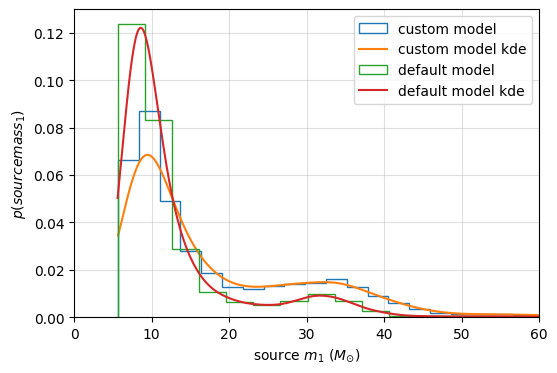
Comparison of mass distribution model (BBH, mass-1, larger mass only).
compare the default mass distribution with the custom mass distribution function defined on the previous example link.
[31]:
# calling the default mass distribution model
mass_1_source, mass_2_source = ler.binary_masses_BBH_popI_II_powerlaw_gaussian(size=10000)
default_model_dict = dict(mass_1_source=mass_1_source)

# calling the custom mass distribution model
mass_1_source, mass_2_source = powerlaw_peak(size=10000)
custom_model_dict = dict(mass_1_source=mass_1_source)
[32]:
import matplotlib.pyplot as plt
from ler.utils import plots as lerplt

# let's do a comparision plot between you custom model and the default model
plt.figure(figsize=(6, 4))
lerplt.param_plot(
    param_name="mass_1_source",
    param_dict=custom_model_dict, # or the json file name
    plot_label='custom model',
);
lerplt.param_plot(
    param_name="mass_1_source",
    param_dict=default_model_dict,
    plot_label='default model',
);
plt.xlabel(r'source $m_1$ ($M_{\odot}$)')
plt.ylabel(r'$p(source mass_1)$')
plt.xlim(0,60)
plt.grid(alpha=0.4)
plt.show()
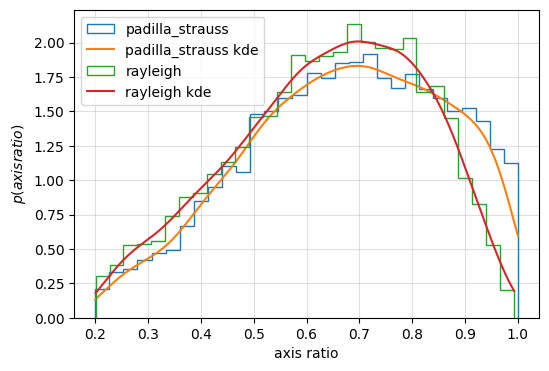
Comparison of Axis-ratio model of the lensing galaxy.
compare the default axis-ratio distribution (gengamma, from SDSS galaxy catalogue, Haris et al. 2018) with axis-ratio distribution from Padilla and Strauss 2008
[28]:
size = 10000
padilla_strauss = ler.axis_ratio_padilla_strauss(size=size)

# axis_ratio_rayleigh depends on the velocity dispersion
sigma = ler.velocity_dispersion_gengamma(size=size)
rayleigh = ler.axis_ratio_rayleigh(sigma=sigma)

# make a dict
axis_ratio_dict = dict(
    padilla_strauss=padilla_strauss,
    rayleigh=rayleigh,
)
axis_ratio_spline_coeff interpolator will be generated at ./interpolator_pickle/axis_ratio/axis_ratio_spline_coeff_0.pickle
axis_ratio interpolator will be generated at ./interpolator_pickle/axis_ratio/axis_ratio_1.pickle
[29]:
# plot the distribution of axis-ratio
plt.figure(figsize=(6, 4))
lerplt.param_plot(
    param_name="padilla_strauss",
    param_dict=axis_ratio_dict,
    plot_label='padilla_strauss',
)
lerplt.param_plot(
    param_name="rayleigh",
    param_dict=axis_ratio_dict,
    plot_label='rayleigh',
)
plt.xlabel(r'axis ratio')
plt.ylabel(r'$p(axis ratio)$')
plt.grid(alpha=0.4)
plt.show()
Generating particular number of detectable events.
this is particularly useful when you want only the detectable events to be saved in the json file
detectable event rates will be calculated at each batches. Subsequent batch will consider the previous batch’s detectable events. So, the rates will become more accurate as the batch number increases and will converge to a stable value at higher samples.
you can resume the rate calculation from the last saved batch.
[33]:
from ler.rates import LeR

# class initialization
ler = LeR(npool=8, verbose=False)
Unlensed case.
SNR>8
[34]:
n_size_unlensed_param = ler.selecting_n_unlensed_detectable_events(
    size=5000,
    snr_threshold=10.0,
    batch_size=100000,
    resume=False,
    output_jsonfile='unlensed_params_n_detectable.json',
    meta_data_file="meta_unlensed.json",
    )
removing ./ler_data/unlensed_params_n_detectable.json and ./ler_data/meta_unlensed.json if they exist
collected number of detectable events =  0
given detectability_condition == 'step_function'
collected number of detectable events =  422
total number of events =  100000
total rate (yr^-1): 436.86662367311965
given detectability_condition == 'step_function'
collected number of detectable events =  841
total number of events =  200000
total rate (yr^-1): 435.31378022404454
given detectability_condition == 'step_function'
collected number of detectable events =  1255
total number of events =  300000
total rate (yr^-1): 433.0707841309361
given detectability_condition == 'step_function'
collected number of detectable events =  1705
total number of events =  400000
total rate (yr^-1): 441.2663467788323
given detectability_condition == 'step_function'
collected number of detectable events =  2094
total number of events =  500000
total rate (yr^-1): 433.5538909817594
given detectability_condition == 'step_function'
collected number of detectable events =  2503
total number of events =  600000
total rate (yr^-1): 431.8630170038777
given detectability_condition == 'step_function'
collected number of detectable events =  2916
total number of events =  700000
total rate (yr^-1): 431.24680928599076
given detectability_condition == 'step_function'
collected number of detectable events =  3325
total number of events =  800000
total rate (yr^-1): 430.2670390145505
given detectability_condition == 'step_function'
collected number of detectable events =  3740
total number of events =  900000
total rate (yr^-1): 430.1951481141304
given detectability_condition == 'step_function'
collected number of detectable events =  4138
total number of events =  1000000
total rate (yr^-1): 428.3777461515092
given detectability_condition == 'step_function'
collected number of detectable events =  4561
total number of events =  1100000
total rate (yr^-1): 429.2435740140238
given detectability_condition == 'step_function'
collected number of detectable events =  4979
total number of events =  1200000
total rate (yr^-1): 429.53375183026515
given detectability_condition == 'step_function'
collected number of detectable events =  5385
total number of events =  1300000
total rate (yr^-1): 428.8236909368846
stored detectable unlensed params in ./ler_data/unlensed_params_n_detectable.json
stored meta data in ./ler_data/meta_unlensed.json

 trmming final result to size=5000
collected number of detectable events =  5000
total number of events =  1207057.0
total unlensed event rate (yr^-1): 428.8235626196801
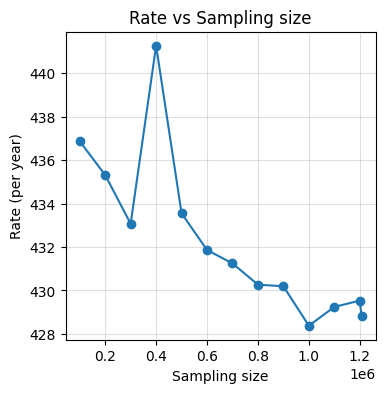
Important Note: At each iteration, rate is calculated using the cummulatively increasing number of events. It will become stable at around 2 million events. This is the number of events that is required to get a stable rate. Below, I am showing visualization of how rate changes with increasing number of events.
[35]:
from ler.utils import get_param_from_json
# getting data from json
meta_data= get_param_from_json("./ler_data/meta_unlensed.json")

# plot the rate vs sampling size
plt.figure(figsize=(4,4))
plt.plot(meta_data['events_total'], meta_data['total_rate'], 'o-')
plt.xlabel('Sampling size')
plt.ylabel('Rate (per year)')
plt.title('Rate vs Sampling size')
plt.grid(alpha=0.4)
plt.show()
Lensed case.
2 images, snr>8 (super-threshold)
1 image, snr>6 (sub+super-threshold)
[36]:
n_size_lensed_param = ler.selecting_n_lensed_detectable_events(
    size=500,
    snr_threshold=[8.0,6.0],
    num_img=[2,1],
    batch_size=50000,
    resume=False,
    output_jsonfile='lensed_params_n_detectable.json',
    meta_data_file="meta_lensed.json",
    )
removing ./ler_data/lensed_params_n_detectable.json and ./ler_data/meta_lensed.json if they exist
collected number of detectable events =  0
100%|███████████████████████████████████████████████████████| 50000/50000 [00:11<00:00, 4299.84it/s]
100%|█████████████████████████████████████████████████████████████████| 1/1 [00:00<00:00, 12.57it/s]
given detectability_condition == step_function
collected number of detectable events =  112
total number of events =  50000
total rate (yr^-1): 0.508493641457471
100%|███████████████████████████████████████████████████████| 50000/50000 [00:11<00:00, 4296.83it/s]
100%|█████████████████████████████████████████████████████████████████| 1/1 [00:00<00:00, 11.66it/s]
given detectability_condition == step_function
collected number of detectable events =  212
total number of events =  100000
total rate (yr^-1): 0.48125291066510645
100%|███████████████████████████████████████████████████████| 50000/50000 [00:12<00:00, 4094.12it/s]
100%|█████████████████████████████████████████████████████████████████| 3/3 [00:00<00:00, 38.02it/s]
given detectability_condition == step_function
collected number of detectable events =  317
total number of events =  150000
total rate (yr^-1): 0.4797395367321973
100%|███████████████████████████████████████████████████████| 50000/50000 [00:11<00:00, 4289.40it/s]
given detectability_condition == step_function
collected number of detectable events =  433
total number of events =  200000
total rate (yr^-1): 0.4914681847122432
100%|███████████████████████████████████████████████████████| 50000/50000 [00:11<00:00, 4318.64it/s]
100%|█████████████████████████████████████████████████████████████████| 1/1 [00:00<00:00, 12.09it/s]
given detectability_condition == step_function
collected number of detectable events =  531
total number of events =  250000
total rate (yr^-1): 0.48216093502485197
storing detectable lensed params in ./ler_data/lensed_params_n_detectable.json
storing meta data in ./ler_data/meta_lensed.json

 trmming final result to size=500
collected number of detectable events =  500
total number of events =  235405.0
total lensed event rate (yr^-1): 0.4821607228741339
[37]:
print(n_size_lensed_param.keys())
print(f"size of each parameters={len(n_size_lensed_param['zl'])}")
dict_keys(['zl', 'zs', 'sigma', 'q', 'theta_E', 'phi', 'e1', 'e2', 'gamma1', 'gamma2', 'gamma', 'geocent_time', 'ra', 'dec', 'phase', 'psi', 'theta_jn', 'luminosity_distance', 'mass_1_source', 'mass_2_source', 'mass_1', 'mass_2', 'x0_image_positions', 'x1_image_positions', 'magnifications', 'time_delays', 'image_type', 'n_images', 'effective_luminosity_distance', 'effective_geocent_time', 'snr_net', 'L1', 'H1', 'V1'])
size of each parameters=500
Using custom detection criteria.
I leverage the ANN (Artificial Neural Network) based SNR calculator from gwsnr. It can predict SNR>8 with 99.9% accuracy for the astrophysical parameters. But to make it 100% accurate, I will recalculate SNR some of the events using inner product method. LeR can do this automatically.
I will test two cases using:
pdet (probability of detection) with ANN
SNR with ANN.
Note: Check out GRB rate calculation example for more details on how to use custom detection criteria.
[38]:
from ler.rates import LeR
from gwsnr import GWSNR
import numpy as np
Defining custom detection criteria (using gwsnr package).
pdet only calculation
[39]:
snr_ = GWSNR(gwsnr_verbose=True, pdet=True, snr_type='ann', waveform_approximant='IMRPhenomXPHM')
psds not given. Choosing bilby's default psds
Intel processor has trouble allocating memory when the data is huge. So, by default for IMRPhenomXPHM, duration_max = 64.0. Otherwise, set to some max value like duration_max = 600.0 (10 mins)
Interpolator will be loaded for L1 detector from ./interpolator_pickle/L1/partialSNR_dict_1.pickle
Interpolator will be loaded for H1 detector from ./interpolator_pickle/H1/partialSNR_dict_1.pickle
Interpolator will be loaded for V1 detector from ./interpolator_pickle/V1/partialSNR_dict_1.pickle

Chosen GWSNR initialization parameters:

npool:  4
snr type:  ann
waveform approximant:  IMRPhenomXPHM
sampling frequency:  2048.0
minimum frequency (fmin):  20.0
mtot=mass1+mass2
min(mtot):  2.0
max(mtot) (with the given fmin=20.0): 184.98599853446768
detectors:  ['L1', 'H1', 'V1']
psds:  [PowerSpectralDensity(psd_file='None', asd_file='/Users/phurailatpamhemantakumar/anaconda3/envs/ler/lib/python3.10/site-packages/bilby/gw/detector/noise_curves/aLIGO_O4_high_asd.txt'), PowerSpectralDensity(psd_file='None', asd_file='/Users/phurailatpamhemantakumar/anaconda3/envs/ler/lib/python3.10/site-packages/bilby/gw/detector/noise_curves/aLIGO_O4_high_asd.txt'), PowerSpectralDensity(psd_file='None', asd_file='/Users/phurailatpamhemantakumar/anaconda3/envs/ler/lib/python3.10/site-packages/bilby/gw/detector/noise_curves/AdV_asd.txt')]
Testing the custom detection criteria.
Pdet calculator test
[40]:
# initialization pdet calculator
pdet_calculator = snr_.snr
mass_1 = np.array([5, 10.,50.,200.])
ratio = np.array([1, 0.8,0.5,0.2])
luminosity_distance = np.array([1000, 2000, 3000, 4000])
# test
pdet = pdet_calculator(
    gw_param_dict=dict(
        mass_1=mass_1,
        mass_2=mass_1*ratio,
        luminosity_distance=luminosity_distance,
    )
)
inner_product_snr = snr_.compute_bilby_snr(
    mass_1=mass_1,
    mass_2=mass_1*ratio,
    luminosity_distance=luminosity_distance,
)

print(f"pdet: {pdet}")
print(f"inner_product_snr: {inner_product_snr}")
100%|█████████████████████████████████████████████████████████████████| 3/3 [00:00<00:00, 16.74it/s]
pdet: {'L1': array([0, 0, 1, 0]), 'H1': array([0, 0, 0, 0]), 'V1': array([0, 0, 0, 0]), 'pdet_net': array([1, 0, 1, 0])}
inner_product_snr: {'L1': array([ 7.4441411 ,  5.85368864, 10.6450267 ,  0.        ]), 'H1': array([4.73471203, 3.72313335, 6.77057773, 0.        ]), 'V1': array([2.23257635, 1.73563894, 3.21070705, 0.        ]), 'snr_net': array([ 9.10039185,  7.15121214, 13.01790904,  0.        ])}
Using custom detection criteria with LeR.
Below is an example of general case of initialising with any type of pdet calculator.
Refer to the documentation example for extra details, where I have used pdet for GRB (gamma-ray-burst) detection.
[41]:
from ler.rates import LeR

ler = LeR(verbose=False, pdet_finder=pdet_calculator, spin_zero=False,
    spin_precession=True)
[42]:
unlensed_param = ler.unlensed_cbc_statistics();
unlensed params will be store in ./ler_data/unlensed_param.json
chosen batch size = 50000 with total size = 100000
There will be 2 batche(s)
Batch no. 1
sampling gw source params...
calculating pdet...
Batch no. 2
sampling gw source params...
calculating pdet...
saving all unlensed parameters in ./ler_data/unlensed_param.json
now calculate rate using the custom ‘pdet’ calculator
[43]:
_, unlensed_param_detectable = ler.unlensed_rate(detectability_condition='pdet')
Getting unlensed_param from json file ./ler_data/unlensed_param.json...
given detectability_condition == 'pdet'
total unlensed rate (yr^-1): 502.08604853427255
number of simulated unlensed detectable events: 485
number of simulated all unlensed events: 100000
storing detectable params in ./ler_data/unlensed_param_detectable.json
[44]:
# # for lensed case
# lensed_param = ler.lensed_cbc_statistics()
# _, lensed_param_detectable = ler.lensed_rate(detectability_condition='pdet')
Analysis: SNR (with ANN) + SNR recalculation (inner product).
[45]:
from ler.rates import LeR

# ler initialization with gwsnr arguments
ler = LeR(npool=6,
    verbose=False,
    snr_type='ann',
    waveform_approximant='IMRPhenomXPHM',
    spin_zero=False,
    spin_precession=True
)
[46]:
unlensed_param = ler.selecting_n_unlensed_detectable_events(
    size=500,
    snr_threshold=10.0,
    batch_size=50000,
    resume=False,
    trim_to_size=False,
    output_jsonfile='unlensed_params_n_detectable_ann.json',
    meta_data_file="meta_unlensed_ann.json",
    snr_recalculation=True,
    snr_threshold_recalculation=[4,20], # it will recalculate SNR for events with (SNR_ANN > 4) and (SNR_ANN < 20)
    )
removing ./ler_data/unlensed_params_n_detectable_ann.json and ./ler_data/meta_unlensed_ann.json if they exist
collected number of detectable events =  0
100%|██████████████████████████████████████████████████████████| 1598/1598 [00:04<00:00, 351.02it/s]
given detectability_condition == 'step_function'
collected number of detectable events =  204
total number of events =  50000
total rate (yr^-1): 422.373418148419
100%|██████████████████████████████████████████████████████████| 1557/1557 [00:04<00:00, 344.99it/s]
given detectability_condition == 'step_function'
collected number of detectable events =  425
total number of events =  100000
total rate (yr^-1): 439.97231057126976
100%|██████████████████████████████████████████████████████████| 1503/1503 [00:04<00:00, 345.51it/s]
given detectability_condition == 'step_function'
collected number of detectable events =  604
total number of events =  150000
total rate (yr^-1): 416.85219699615203
stored detectable unlensed params in ./ler_data/unlensed_params_n_detectable_ann.json
stored meta data in ./ler_data/meta_unlensed_ann.json
[47]:
# # Uncomment the below code if you need to compare with the rate calculation using inner product snr

from ler.rates import LeR

# # ler initialization with gwsnr arguments
# ler = LeR(npool=6, verbose=False, snr_type='inner_product', waveform_approximant='IMRPhenomXPHM', spin_zero=False,
#     spin_precession=True)

# unlensed_param = ler.selecting_n_unlensed_detectable_events(
#     size=1000,
#     snr_threshold=10.0,
#     batch_size=50000,
#     resume=False,
#     output_jsonfile='unlensed_params_n_detectable.json',
#     meta_data_file="meta_unlensed.json",
#     )
[48]:
lensed_param = ler.selecting_n_lensed_detectable_events(
    size=500,
    snr_threshold=[8.0,8.0],
    num_img=[1,1],
    batch_size=50000,
    resume=False,
    output_jsonfile='lensed_params_n_detectable_ann.json',
    meta_data_file="meta_lensed_ann.json",
    snr_recalculation=True,
    snr_threshold_recalculation=[[4,4], [20,20]], # it will recalculate SNR for events with (SNR_ANN > 4) and (SNR_ANN < 20)
)
removing ./ler_data/lensed_params_n_detectable_ann.json and ./ler_data/meta_lensed_ann.json if they exist
collected number of detectable events =  0
100%|███████████████████████████████████████████████████████| 50000/50000 [00:11<00:00, 4310.16it/s]
calculating snrs...
100%|██████████████████████████████████████████████████████████| 1538/1538 [00:04<00:00, 382.74it/s]
100%|██████████████████████████████████████████████████████████| 1538/1538 [00:03<00:00, 389.81it/s]
100%|██████████████████████████████████████████████████████████| 1084/1084 [00:02<00:00, 363.55it/s]
100%|████████████████████████████████████████████████████████████| 964/964 [00:02<00:00, 377.48it/s]
given detectability_condition == step_function
collected number of detectable events =  220
total number of events =  50000
total rate (yr^-1): 0.9988267957200324
100%|███████████████████████████████████████████████████████| 50000/50000 [00:11<00:00, 4299.16it/s]
calculating snrs...
100%|██████████████████████████████████████████████████████████| 1436/1436 [00:03<00:00, 387.69it/s]
100%|██████████████████████████████████████████████████████████| 1436/1436 [00:03<00:00, 389.49it/s]
100%|██████████████████████████████████████████████████████████| 1011/1011 [00:02<00:00, 375.16it/s]
100%|████████████████████████████████████████████████████████████| 884/884 [00:02<00:00, 375.81it/s]
given detectability_condition == step_function
collected number of detectable events =  430
total number of events =  100000
total rate (yr^-1): 0.9761261867263953
100%|███████████████████████████████████████████████████████| 50000/50000 [00:11<00:00, 4311.48it/s]
100%|█████████████████████████████████████████████████████████████████| 1/1 [00:00<00:00, 11.26it/s]
calculating snrs...
100%|██████████████████████████████████████████████████████████| 1525/1525 [00:03<00:00, 381.67it/s]
100%|██████████████████████████████████████████████████████████| 1525/1525 [00:03<00:00, 390.52it/s]
100%|██████████████████████████████████████████████████████████| 1066/1066 [00:02<00:00, 375.39it/s]
100%|████████████████████████████████████████████████████████████| 919/919 [00:02<00:00, 379.79it/s]
given detectability_condition == step_function
collected number of detectable events =  662
total number of events =  150000
total rate (yr^-1): 1.0018535435858507
storing detectable lensed params in ./ler_data/lensed_params_n_detectable_ann.json
storing meta data in ./ler_data/meta_lensed_ann.json

 trmming final result to size=500
collected number of detectable events =  500
total number of events =  113293.0
total lensed event rate (yr^-1): 1.001853997759663
[49]:
ler.rate_ratio();
unlensed_rate: 416.85219699615203
lensed_rate: 1.001853997759663
ratio: 416.0807841544908
[ ]: